Anxiety isn't one thing. It's a pattern, specific to you, structured in a particular way, playing out differently across different parts of your life.
The APT Profile maps that pattern across 10 areas of your life, names what's driving it and shows you where the biggest cost is coming from.
Get your APT ProfileYou've been told to manage your anxiety. You've never been told what specifically you're managing.
That's the gap most anxiety tools sit in. They measure how anxious you feel, how often the symptoms show up, how much it's affecting your life. None of that tells you why it's happening or what to do with it.
APT does something different. It measures the structure underneath. Two people can have identical symptoms and completely different underlying patterns. You can work with the pattern.
Your scores map onto the Ladder of Growth (LOG), a five-stage developmental measurement model. Every score on your report reflects a current state, not a fixed personality type. Your scores can move. The model shows you what direction they're moving in.
The five stages show how your internal system is currently operating in relation to anxiety. You might be operating from a defensive, reactive place. You might be aware of your patterns but circling inside them. You might be moving at speed. You might have built a stable, purposeful system with reliable recovery. Or you might have reached a place where anxiety functions as information rather than as a state.
Your report introduces these five stages in detail and shows you which one your current scores reflect.
The Profile gives you a complete picture of where anxiety is active in your life, what's driving it and how it's structured overall.
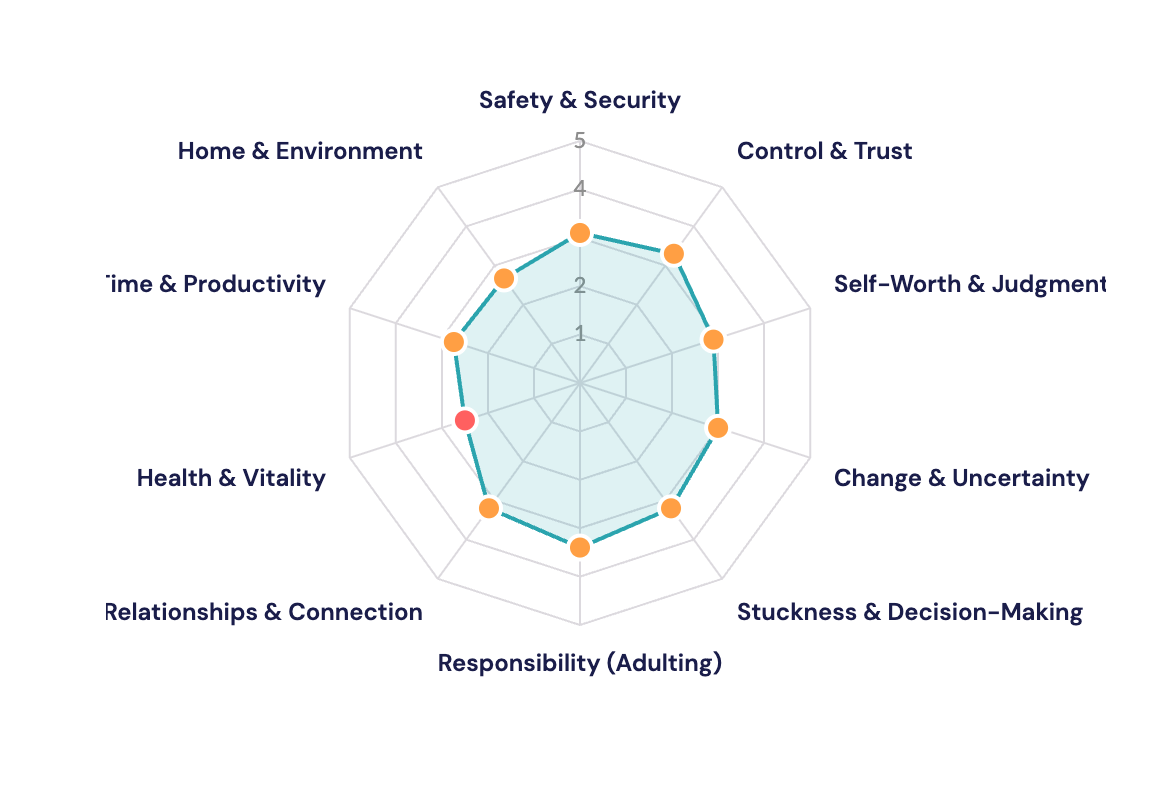
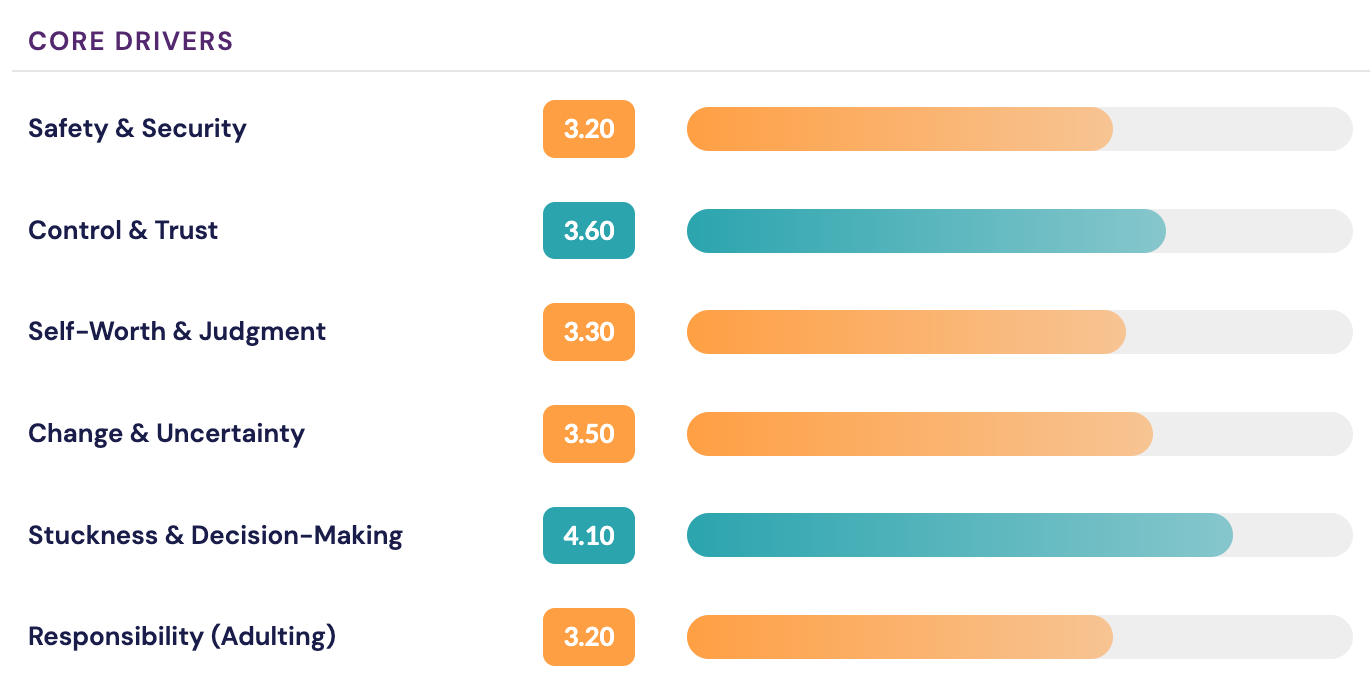
APT maps your anxiety across safety and security, control and trust, self-worth and judgment, change and uncertainty, stuckness and decision-making, responsibility, relationships and connection, health and vitality, time and productivity and home and environment.
For each category, you get a score on the Ladder of Growth, telling you where your system is currently operating in that area. Your three biggest growth edges are named first, so you know immediately where to focus.
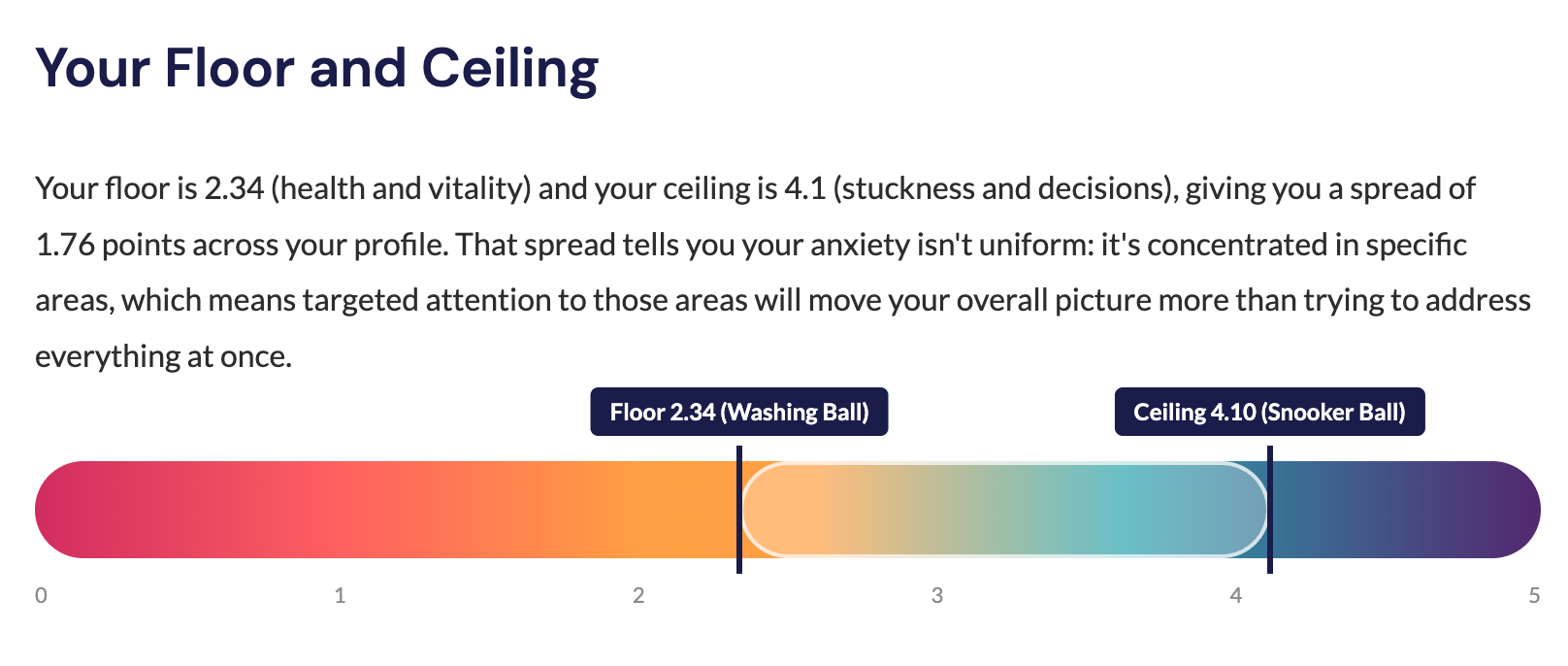
Your floor is your lowest-scoring category. Your ceiling is your highest. The spread between them tells you something important about how concentrated your anxiety is. If your spread is narrow, your anxiety is relatively even across your life. If it's wide, it's concentrated in specific areas, and that's where you'll move your overall picture the most.
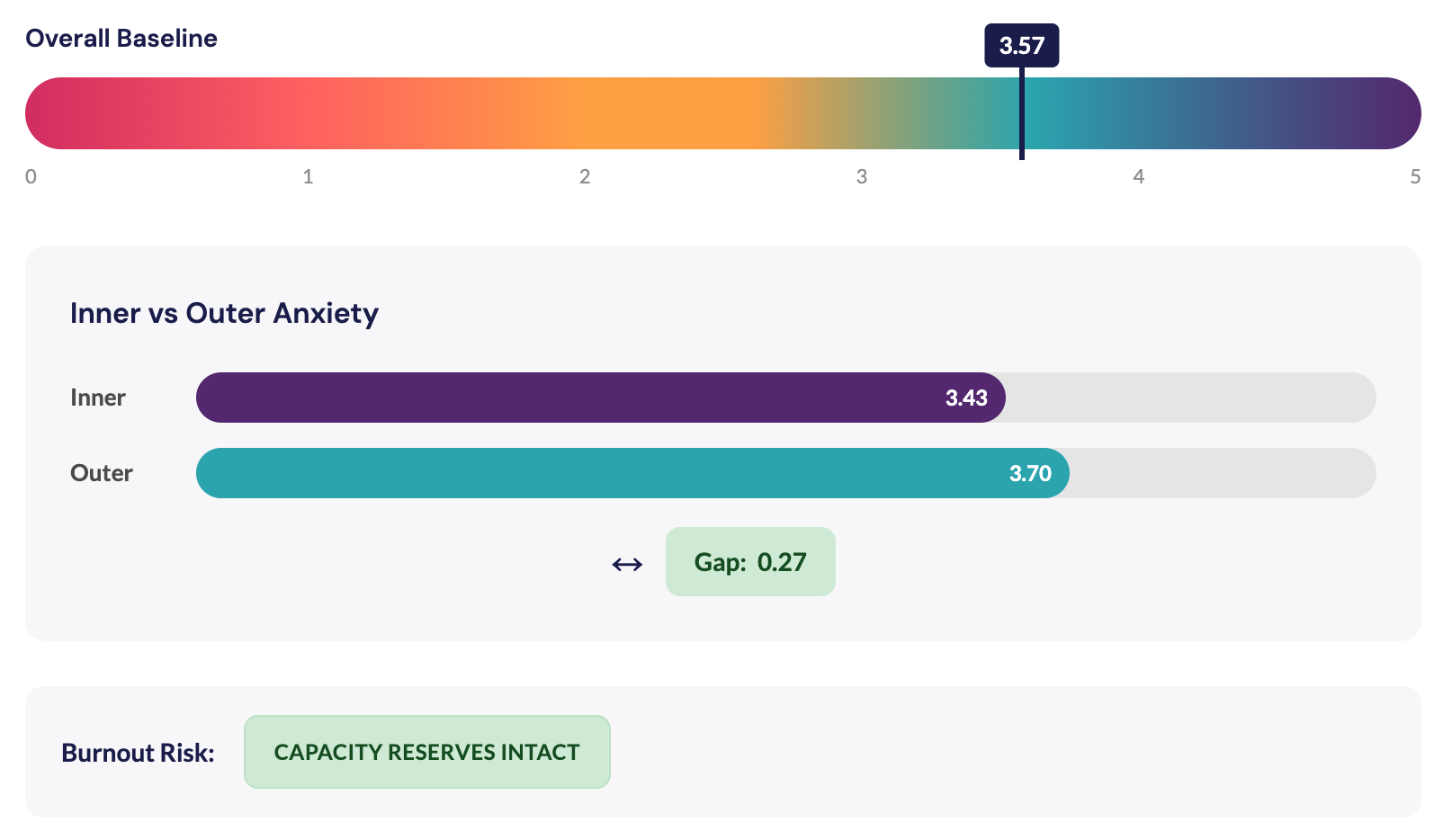
The Profile includes an overall reading of the gap between how you feel internally and how you function externally. That gap is the burnout signal. You'll see one of three levels:
This tells you whether your current patterns are sustainable or whether something needs to shift before it becomes a bigger problem.
Rachel
Mother and founder
Anxious people, we have all this stuff coming up, floating about. Am I this? Am I that? Even having it written down reduces anxiety.
90 questions, organised across three stages. Around 15 minutes start to finish.
How safe you feel in the world and how you relate to control and uncertainty. These two categories shape how anxiety plays out everywhere else, which is why they come first.
3 to 4 minutes
Self-worth and judgment, change and uncertainty, stuckness and decision-making, responsibility. The most diagnostically rich layer, where the internal architecture of anxiety lives.
5 to 6 minutes
Relationships and connection, health and vitality, time and productivity, home and environment. Where anxiety lands in the practical parts of your day.
4 to 5 minutes
Before you start, you'll see a short framing screen explaining how to engage with the questions.
Whichever option you pick, you take the same assessment. If you decide to go deeper later, your results are generated from the same answers. No need to retake.
Your complete anxiety map across 10 areas of life
One-off purchase. Yours to keep.
Everything in the Profile, plus the full inner/outer breakdown
One-off purchase. Yours to keep.
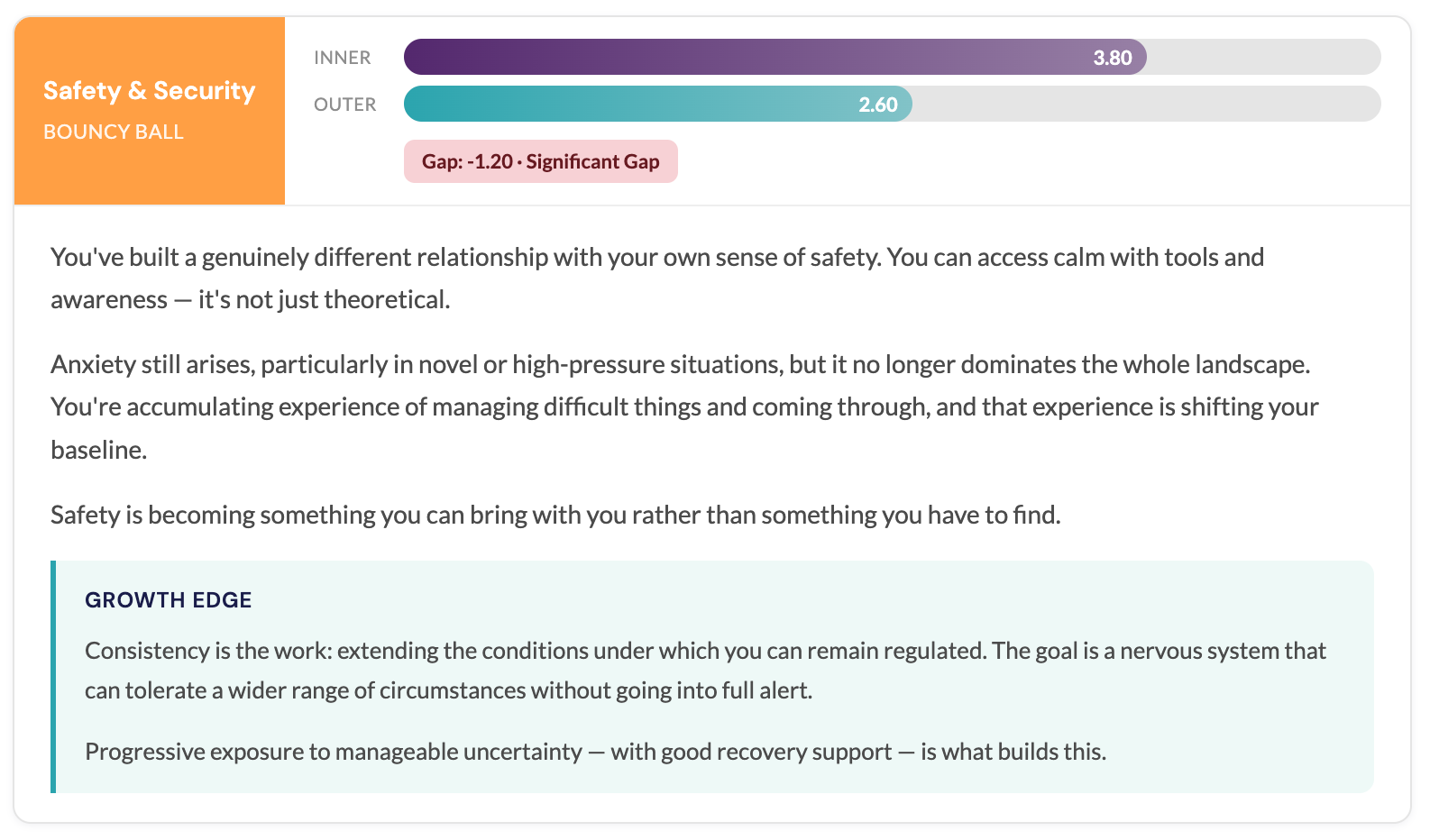
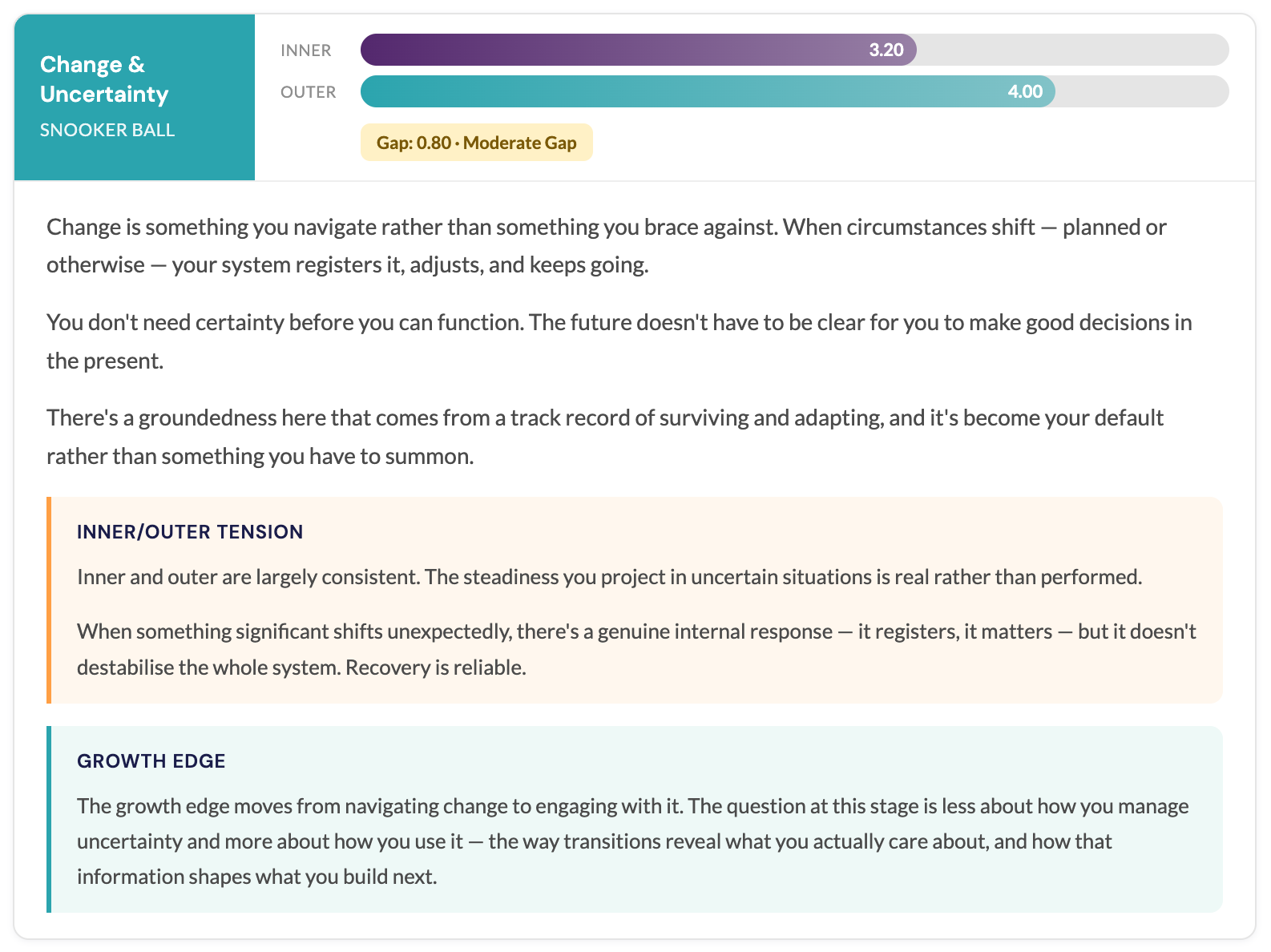
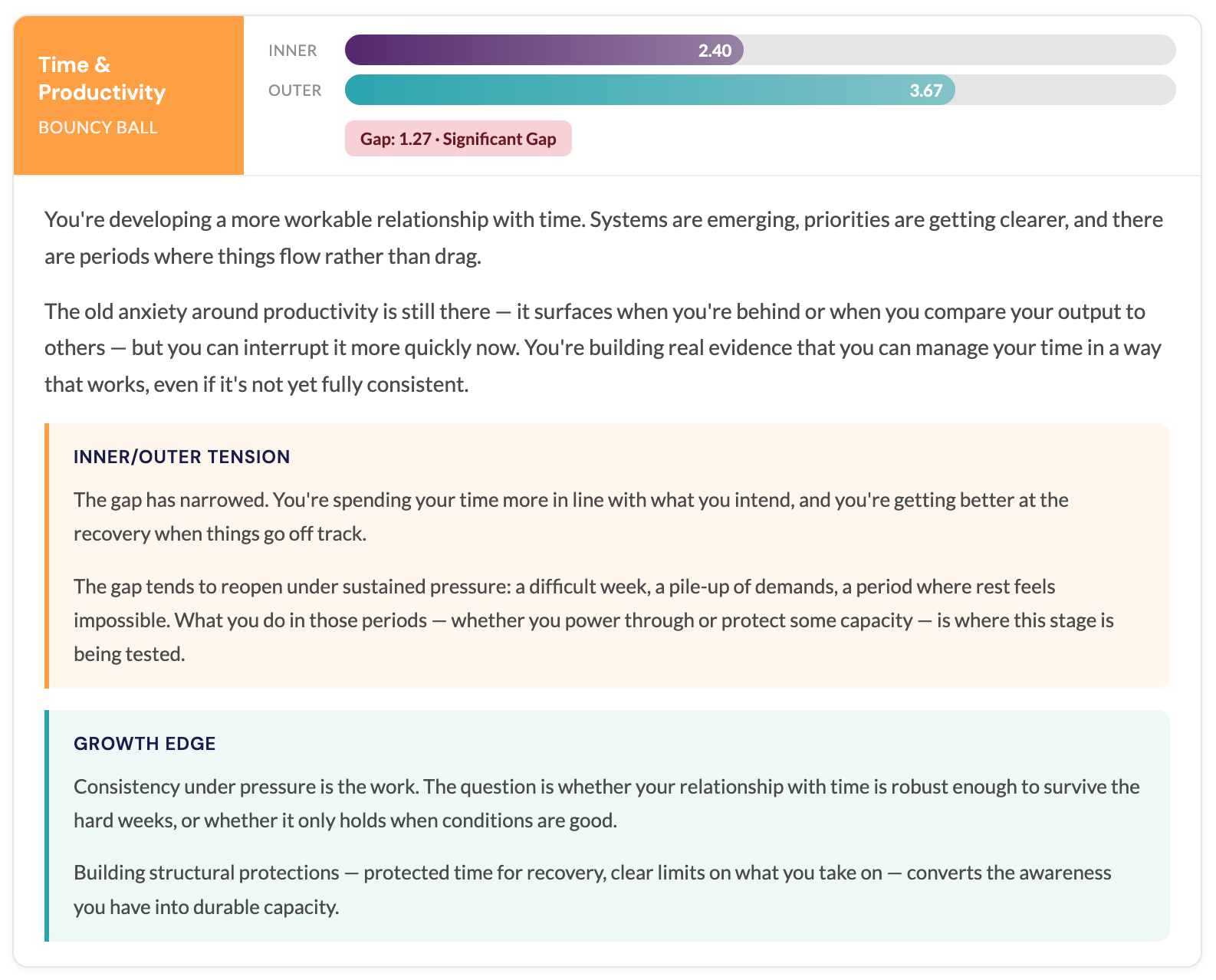
The Profile gives you the overall picture. The Blueprint breaks it open, category by category. You see not just where anxiety lives, but exactly where your internal experience and external functioning are pulling in different directions.
How you feel. The emotional and physiological reality underneath the surface.
How you function. What's visible in practice. What the world sees.
When you see a wide gap between these two scores, that's your signal. It tells you something specific about where anxiety is costing you the most.
For every category, the Blueprint describes what the gap between inner and outer means for you. Where you're over-functioning. Where something isn't visible from the outside. Where the cost is concentrated. You don't have to guess what the numbers mean. Your report translates them into specific, recognisable patterns.
The Blueprint identifies which of 13 named Growth Expressions you're currently in, which Growth Pathway your pattern is most consistent with and what kind of support tends to work at this stage. It also names what tends not to work, and why. This is what practitioners spend years building through intuition. The Blueprint does it from the data in one pass.
Two people can deliver the same work, hit the same targets and look equally fine from the outside. One spent two sleepless nights on every decision. The other didn't.
External output: identical. Internal cost: completely different.
That gap is where burnout risk lives. It's where exhaustion that doesn't resolve with rest comes from. It's why "I'm fine" can be technically true and completely misleading at the same time.
You get a burnout risk reading in both the Profile and the Blueprint. The Profile gives you the overall level. The Blueprint shows you exactly which categories are driving it.
James
Former engineer
It both confirmed my positives and negatives in such a way that I understood them better.
Anna
Long-term therapy client
Eye-opening but also not surprising at the same time.
Sarah
Therapist (NY)
It shows me that my anxiety is more real than maybe I give it credit for. Now I can work on it and I don't have to push it into the background.
James
Former engineer
It was me. It was definitely me that was reported. There was nothing that jumped out. It was a case of, that's me.
Dr Emma
Former GP
I think everyone's got things that they want to work on.
If you've tried therapy, coaching or self-help programmes and bounced off the workload, APT is built differently.
You take the assessment once. You get the reading. No homework. No ongoing sessions. No six-week programme. It tells you where you are, what's driving it and what the pattern looks like. That's the product.
Some people use the report on its own and find that having the picture is enough to start moving. Some use it as a primer before therapy or coaching, so they can spend the first sessions on the right things. Some use it to track change over time, taking the assessment again three or six months later to see whether something has shifted.
There's no obligation attached. You get the reading and you decide what to do with it.
Rachel
Mother and founder
I did try counselling and doing homework, and that's again extra mental load that I had to carry. And it fell through.
90 questions. 15 minutes. Results in 5 minutes.
Want the full inner/outer breakdown and growth pattern reading? Start with the Blueprint instead.
12 to 15 minutes start to finish. You can pause between stages.
Within about two minutes. You'll read it on screen and receive an email link so you can come back to it any time.
The Profile gives you your overall picture: 10 category scores, your floor and ceiling, your burnout risk level and the cascade pattern. The Blueprint goes deeper: you get the inner and outer scores for every category, the full gap analysis, your Growth Expression and what kind of support tends to work at your stage. Both use the same assessment data. You can start with the Profile and upgrade to the Blueprint later without retaking anything.
Yes. A re-assessment after three or six months shows you what has moved and what hasn't. That's where the longitudinal value of APT lives.
No. APT is a developmental measurement tool. It maps how your anxiety is structured. It doesn't diagnose anxiety disorders and doesn't replace clinical care.
No. Each product is complete on its own. If you decide to go deeper, the upgrade generates from the data you've already given, no retake.
Yes. Your report is yours. You receive a link by email and you decide whether to share it.